Designing For Effective Public-Private Partnerships
Our most stubborn challenges can't be solved by wielding a bigger hammer. What the world's most "wicked problems" require is a smarter toolset and a better organized crew that's primed to achieve greater collective impact.
Some days, it feels like we're completely overwhelmed. Health, energy, poverty, development, the environment: these are monumental challenges, which dedicated organizations have been working on around the clock to achieve the most modest of gains. Unfortunately, it seems we're past the point where one organization can hope to deal with anything alone. Our most stubborn challenges can't be solved by wielding a bigger hammer; the world's "wicked problems" require a smarter toolset and a better organized crew.
 Historically, America has relied on government as its Mr. Fixit. But the public sector is paralyzed by partisanship, with a negative feedback loop of austerity measures prohibiting it from tackling any meaningful. In the private sector, corporations have shown but a cosmetic commitment to responsibility, while for-profits operating in human services seem content to milk challenges for whatever they're worth. (After all, the money's in treatment, not the cure.)
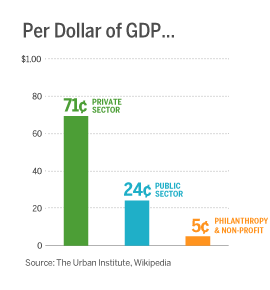
Then there's the nonprofit sector, which has traditionally taken the lead on social and environmental challenges. The heroic dedication of nonprofit organizations notwithstanding, the math just isn't there. Research from the Urban Institute highlights the challenge: for every dollar of GDP, about 24¢ goes to the public sector while only 5¢ goes to philanthropy. Even under the best of scenarios, it's hard to imagine how philanthropists can possibly fill the gap.
So how do we tackle these biggest challenges? I'm no Tom Friedman, so I'll spare you sweeping roadmap to Camelot 3.0 and cut to the obvious: it's going to require collaboration, lots of creative solutions, and experimentation to see what works best. In short, we'll need design thinking —and lots of it.
Design thinking is not new, though it is enjoying a resurgence everywhere from the business world to education reform. The key difference between design thinking and it's more conventional, scientific cousin is that rather than focusing on the parameters of the problem, it focuses on the context of the solution. It asks what our unmet needs are, explores a variety of creative ways to satisfy them, then tests them before implementing the one that works best.
Consider health care. Conventional thinking says, "We want to be healthy. So let's use the technologies we already have (insurance companies, hospitals, etc) and set up a system so we see a doctor when we get sick." Design thinking says, "We want to be healthy. So let's look at all the factors that go into making people healthy, then create the most effective, efficient possible system to achieve that." The beauty of this process is that it isn't hemmed in; rather than focusing on the set of tools we have to work with, it focuses on the tools we might need to get the job done right. It enables us to design systems where incentives are aligned, which in turn makes them more sustainable.
One of the most promising applications of design thinking to affect social change has been in Public Private Partnerships (PPP). We've learned a lot about PPP's over the last few years, designing for nonprofits such as World Cocoa Foundation, Touch Foundation, and The Institute for Industrial Productivity, all of whom bring together the private and public sector to help create sustainable change across a range of critical issues. While there are a variety of schemes and structures PPPs can take, these collaborations between public and private sector offer a variety of benefits, and serve as a model for tackling tough challenges large and small.
Here are a few of the ways PPPs use design thinking to drive social change:
- They enhance collaboration. Like all good design processes, PPPs convene stakeholders and experts across a range of industries, both public and private. This helps mix deep analytic thinking with broad, synthetic understanding to help address challenges in ways that haven't been thought of before.
- They are designed to be more sustainable. Not only do PPPs convene diverse range of stakeholders, but they can also be structured in a way that aligns incentives for each partner within the context of the greater goal. By creating an engagement where incentives are aligned, they can drive solutions that can be more sustainable and scalable.
- They iterate more quickly. Designers often practice rapid iteration to explore concepts and arrive at solutions. But when it comes to the public sector, rapid doesn't exactly come to mind. PPPs can change that. Some enterprises, such as social impact bonds, are designed to pilot new approaches in discrete programs. More short, fast programs make for a faster exploration process, creating a broader range of workable options.
- They are driven by results. Just as design is driven by measurable goals, PPPs are driven by quantitative and qualitative impact. This helps evaluate alternatives during the exploration phase, and ensure that the implemented solutions continue to evolve and perform.
Of course, there are many other of other applications for design thinking in tackling social challenges. And design thinking, in and of itself, doesn't guarantee success. But by adopting some of its principles and techniques, together we can begin to fail faster—with each failure bringing us one step closer to success.

Recent Insights
Related Projects
 Electrification Roadmap Policy Reports
 The Aspen Institute AGLN Fellow Exchange
 The Yale Center for Business and the Environment | CBEY Website